From "Build Us Our Own ChatGPT" to a Working Multimodal AI Platform in Two Weeks
Some product ideas arrive as a feature request. Others arrive as a question that's bigger than it sounds.
Some product ideas arrive as a feature request. Others arrive as a question that's bigger than it sounds.
This one started with a creative technology company that already had a suite of AI tools in production - audio editors, image generators, file storage, character chat experiences, website builders. Each tool worked well on its own. But the company kept hearing the same thing from users and from their own team: why do I have to jump between five different apps to finish one piece of work?
The customer asked us:
"Can we build something like ChatGPT or Claude, but ours - one assistant that can write, generate images, make videos, browse the web, build a website, and actually get creative work done end to end?"
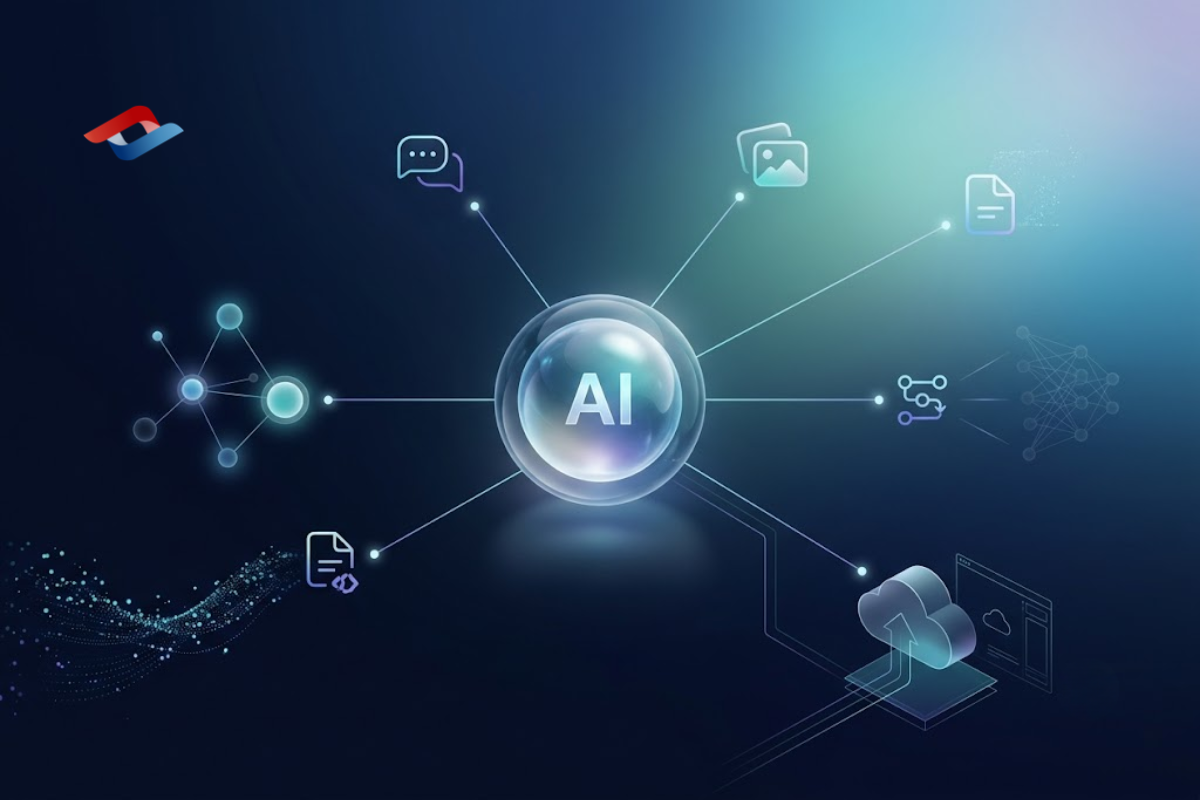
That question became the seed for a product: a multimodal, general-purpose AI platform that could understand text, generate and edit images, produce audio and video, browse the live web, write and execute code, and orchestrate dozens of specialized tools behind a single conversational interface.
It was ambitious, and it was risky in a very specific way. Building a chatbot is easy. Building an agent that reliably picks the right tool out of fifty options, every time, without silently failing halfway through is where most systems quietly break.
The question was not only what to build. It was how to build something this broad without it collapsing under its own ambition - and to get a usable version in front of users fast enough to learn from real behavior instead of guesses.
Our answer was the same AI-native two-week delivery model we use across every MVP engagement. We used ChatGPT and Gemini to synthesize discovery, Figma AI and Claude Design to move from rough workflow to usable screens, Linear AI to convert scope into a clear sprint plan, Codex and Claude Code to accelerate production engineering, v0 and Lovable to explore interface options, Replit to test small technical ideas, and OpenClaw-style multi-agent workflows to run implementation, review, testing, and documentation in parallel.
The result was not a tech demo. It was a working assistant that could actually finish tasks.
The Customer Idea
The original idea sounded simple: one chat box that can do everything. But during discovery, we learned that the real product was not "a chatbot with more features." The real need was a reliable orchestration layer sitting on top of genuinely useful creative capabilities.
The customer did not want a flashy demo that fell apart on the second message. They wanted a product that could:
"Build an agentic assistant that knows what it doesn't know how to do itself - and reliably hands the task to the right specialized tool instead of guessing."
That framing changed everything about how we approached the build.
Week 1: Turning Vision Into an MVP Scope
We began with a requirement capture process designed around real user tasks, not feature lists.
The tools and methods included:
Stakeholder interviews
With product, engineering, and creative teams using it daily.
FigJam
Mapping user journeys across writing, music, and marketing tasks.
Notion
For capturing decisions, assumptions, and open questions.
ChatGPT and Gemini
Summarizing interviews and identifying the most attempted tasks.
Notion
Maintaining the decision log, assumptions, and MVP scope.
Figma AI and Claude Design
Prototyping the conversational workspace, generation panels, and library.
Linear AI
Converting approved scope into epics, tasks, and acceptance criteria.
Sample tasks
Real prompts and files used to test orchestration accuracy.
Tool inventory matrix
Mapping every capability against intents users express in language.
The key discovery was that users did not want more options. They wanted the assistant to stop asking them to choose.
So we designed every interaction to answer three questions:
The Intent
What is the user actually trying to do?
The Tool
Which capability, model, or workflow can actually do it?
The Outcome
What does the user see, and can they keep working from there?
This principle shaped the whole product.
By the end of the requirement phase, we had a focused product definition: not "an AI that can do anything," but an assistant that quietly picks the right specialist for the job and hands back a finished result
Architecting an Agent That Doesn't Fall Over
A platform orchestrating 50+ tools cannot be built as one giant prompt and a prayer. Every step needs to be observable, recoverable, and explainable when it goes wrong. We designed the architecture around six major capabilities:
Conversational interface
A single chat surface where users could type, upload files, or speak, and get back text, images, audio, video, or finished documents in the same thread.
Intent and tool routing
A reasoning layer that classified what the user wanted and selected from a growing library of internal tools and external model APIs - instead of one model trying to do everything itself.
Multimodal generation layer
Dedicated integrations for text, image, audio, and video generation and editing, each tuned to the model best suited for that job rather than a single one-size-fits-all approach.
Knowledge and file intelligence
Document parsing, summarization, and retrieval so users could upload a PDF, transcript, or reference file and have the assistant reason over it directly.
Live web and execution capability
Web browsing for current information, plus the ability to write and run code, build simple websites, and assemble presentations on request.
Asset and session management
A unified drive layer so every generated image, track, video, and document was stored, searchable, and reusable across sessions instead of disappearing into a chat log.
The technology choices were practical
"The architecture deliberately separated routing, generation, and memory. That made fifty tools feel like one assistant instead of fifty buttons."
Week 2: Building Around the User's Workflow
The first product screen we designed was not a settings page or a model picker. It was the conversation itself. That was where trust was won or lost.
TThe experience needed to handle:
The interface had to feel simple on the surface while doing a lot of coordination underneath. Users do not want to see fifty tools. They want to feel like they are talking to one capable assistant.
To move fast, we used design and engineering tools in parallel:
v0 and Lovable
Explored conversational layouts, generation panels, and asset library views.
Figma AI and Claude Design
Refined the selected direction into a coherent, usable product flow.
Codex
Accelerated frontend implementation, API wiring, refactoring, and test fixes.
Claude Code
Handled backend orchestration logic, routing edge cases, and integrations.
ChatGPT and Gemini
Created realistic test prompts, user scenarios, and documentation drafts.
Replit
Validated small generation and routing experiments before main integration.
Linear AI
Kept the sprint plan current as scope decisions evolved.
OpenClaw-style multi-agent workflows
Let engineering, QA, prompt tuning, and docs move simultaneously.
Focused MVP Modules
This was not an uncontrolled AI build. Every tool integration had a defined job and a fallback path. Every routing decision was tested against real prompts before it shipped.
This is where AGSFT Digital's AI-native development approach mattered most. AI accelerated code generation, prompt iteration, and interface exploration. But every orchestration path was reviewed by engineers and stress-tested against the messy, ambiguous way real users actually phrase requests.
"Fast delivery only matters if the assistant still works on the tenth weird prompt, not just the first clean demo."
The Two-Week Delivery Rhythm
The delivery was structured, visible, and fast:
Discovery & Scope Freeze
Stakeholder interviews, task mapping, AI-assisted discovery synthesis, tool inventory, and MVP boundary.
Visualization & Logic
Figma flows, Claude Design exploration, v0 and Lovable UI options, routing architecture plan, and Linear backlog.
AI-Native Build
Parallel engineering with Codex, Claude Code, and human-led implementation across the chat interface, tool routing, generation integrations, and asset drive.
Hardening & Review
Scenario testing across ambiguous and edge-case prompts, fallback-path testing, generation quality review, and routing-accuracy evaluation.
Launch & Handover
Production hardening, monitoring, deployment, documentation, and handover.
This is how a sprawling product idea becomes a usable MVP in two weeks. The process compresses weeks of analysis, design, development, and QA into a coordinated sprint without pretending that AI replaces engineering judgment - especially when the product is a layer of judgment sitting on top of other AI models.
Delivery: What the MVP Included
The delivered MVP included:
The product did not try to be the best tool at any single creative task. It focused on being the most reliable front door to all of them.
That made the MVP immediately useful.
The Business Impact
The customer could now offer a single, coherent assistant experience instead of a collection of disconnected tools.
The real outcome was reduced friction.
Users could move from idea to finished asset without leaving the conversation. Creative teams could iterate on images, audio, and video in the same thread instead of re-uploading work between apps. Product teams gained a foundation they could keep extending with new tools without redesigning the core experience. Leadership gained a credible answer to the question every creative software company is now being asked: what is your AI story?
Most importantly, the business gained a platform, not a prototype. That is what turns an ambitious idea into a product asset.
What This Story Says About AGSFT Digital
Many businesses already have the ingredients for a powerful AI platform: specialized tools, real user demand, and a clear sense of the experience they want to offer. The challenge is making fifty moving parts feel like one dependable assistant.
AGSFT Digital helps customers do exactly that. Our process is built around:
Understanding real user tasks before choosing the architecture.
Using ChatGPT, Gemini, and structured workshops to translate an ambitious idea into a focused MVP scope.
Using Figma AI, Claude Design, v0, and Lovable to move quickly from concept to clickable product direction.
Using Linear AI to keep sprint execution clear and visible.
Using Codex, Claude Code, Replit, and OpenClaw-style multi-agent workflows to accelerate development without losing engineering control.
Designing orchestration architecture that stays reliable as the number of tools and models keeps growing.
Delivering production-ready software with monitoring, testing, and documentation.
In this product story, the customer did not need "an AI demo." They needed a dependable assistant, a coherent experience across formats, and a platform that could keep absorbing new capability without breaking what already worked.
Closing Thought
The next wave of creative software will not be ten separate AI tabs open at once.
The Vision
It will be a single, trustworthy assistant that knows which specialist to call, when to call it, and how to hand work back to a human the moment it matters - built on an architecture that can keep growing without losing reliability.
That is the kind of product AGSFT Digital is built to deliver: a believable, useful MVP in two weeks, powered by the right AI tools and guided by experienced product engineers.